


Media Release
Meet Maple: Toronto Zoo Officially Names Adorable Pygmy Hippo Calf
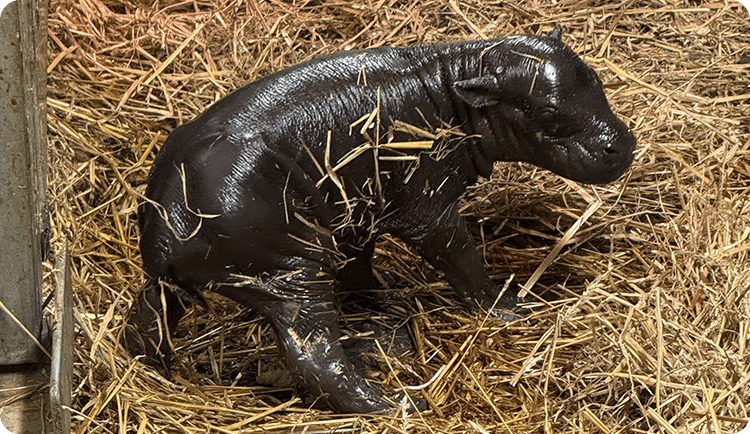
TORONTO, ON, Thursday, August 6, 2026: She arrived weighing less than a bag of flour, and in four short days she has captured the hearts of a city. Today, your Toronto Zoo is delighted to announce that the female endangered pygmy hippopotamus calf born on Sunday, August 2nd now has an official name: Maple.
The name was selected by the Zoo’s Wildlife Care team following an internal shortlist process that invited keepers, veterinary staff, horticulture crews and volunteers to submit suggestions rooted in Canadian identity and in the forested habitats that pygmy hippos call home in West Africa. More than 300 names were submitted in 72 hours. Maple was the runaway favourite.
Why Maple?
“Maple felt right the moment we said it out loud,” said Dr. Alina Ferreira, Chief Executive Officer at your Toronto Zoo. “It is unmistakably Canadian, it speaks to trees and forests and the kind of habitat this species depends on, and it carries a sense of sweetness that anyone who has watched this calf splash around simply cannot argue with. She is a small ambassador for a species most people have never heard of, and a name people remember is the first step toward a species people protect.”
There is a second layer to the choice. Pygmy hippos are forest animals, not open-water grazers like their much larger common hippo cousins. They live in the dense, closed-canopy rainforests and swamp forests of Liberia, Sierra Leone, Côte d’Ivoire and Guinea, moving along narrow trails through the understory at dusk. Tying the calf’s name to a tree was a deliberate reminder that saving this species means saving forest.
How Maple is doing
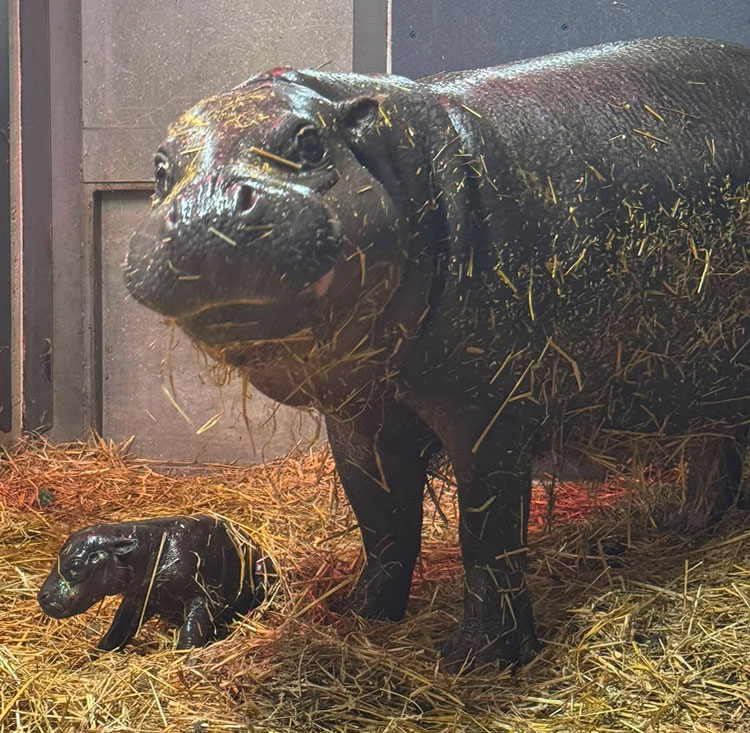
Maple weighed 5.9 kilograms at her first exam and has already gained close to a kilogram, a trajectory the veterinary team describes as textbook. Newborn pygmy hippos typically weigh between 4.5 and 6.2 kilograms at birth and should put on roughly 200 to 300 grams a day in the early weeks. Maple is nursing well, sleeping in long, settled stretches, and has begun the clumsy, splay-legged trotting that keepers consider the surest sign of a confident calf.
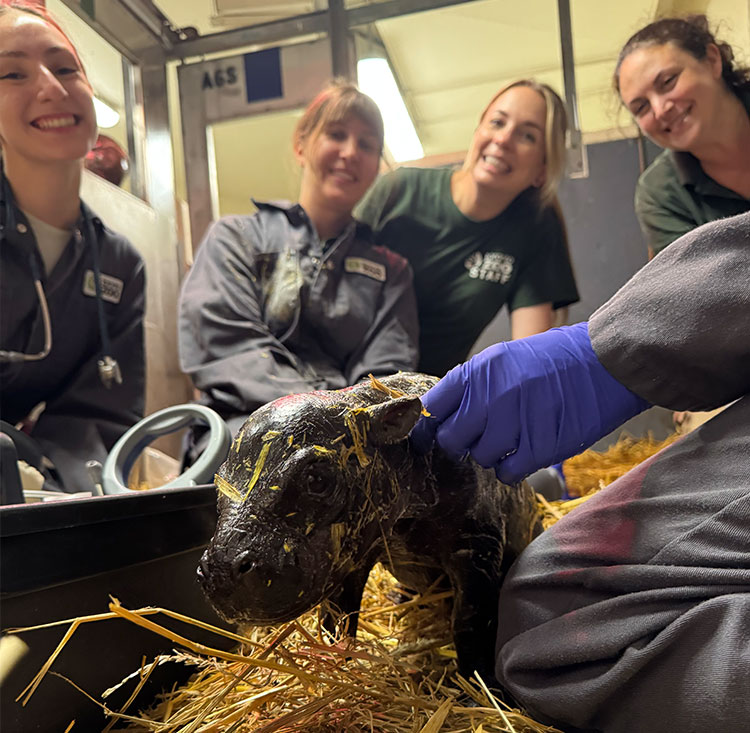
“Every number we track is where we want it to be,” said Dr. Priya Raman, Head Veterinarian. “Her hydration is excellent, her respiratory rate is stable, her skin is producing the natural pink secretion that protects pygmy hippos from sun and bacteria, and her weight gain curve is right in the middle of the healthy range. We are cautiously optimistic, and I want to stress the word cautious. The first 30 days matter enormously for this species, and we will keep her under 24-hour camera observation until we are confident she is past the highest-risk window.”
The team is deliberately hands-off. Care staff conduct visual health checks at scheduled intervals and step in only when necessary, allowing Maple’s mother to do what she does best. Weights are captured on a low-profile scale the calf walks across voluntarily, and any handling is kept brief and quiet.
“She has a personality already,” said Marcus Oyelaran, Wildlife Care Supervisor, Africa Pavilion. “She is nosy. She investigates the hay, the water, the corners of the stall, the boots we are wearing. Her mother is patient and enormously attentive, which is exactly what you hope for. Watching a first-time visitor to this planet figure out how a pool works is one of the great privileges of this job.”
A species running out of forest
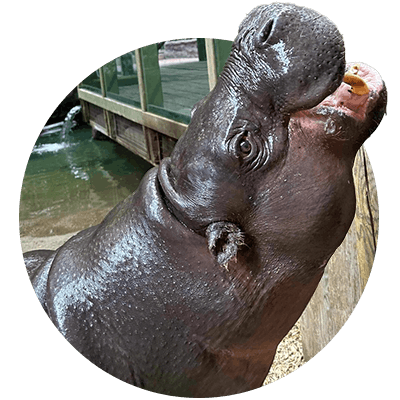
The pygmy hippopotamus is listed as Endangered on the IUCN Red List. Fewer than an estimated 2,500 mature individuals remain in the wild, spread across four West African countries, and the population continues to decline. Roughly 80 per cent of the remaining wild animals are believed to live in Liberia, where logging, agricultural conversion, mining concessions and road building have fragmented the forest into shrinking islands. Hunting for bushmeat compounds the pressure.
Because the species is nocturnal, solitary and exceptionally shy, reliable field data is scarce. Researchers rely heavily on camera-trap grids and dung surveys, and a single confirmed sighting can justify months of protection work in a given watershed.
Maple’s birth was recommended through a cooperative breeding programme that manages the regional population of pygmy hippos as a single, carefully tracked gene pool. Every pairing is evaluated for genetic representation, age structure and the welfare of the individual animals involved. Calves like Maple are not surplus; they are the reason a safety-net population can remain viable for the century ahead.
What your Zoo is doing in the field
Beyond the breeding programme, your Toronto Zoo supports on-the-ground forest protection through its conservation grants stream. Current commitments include funding for community ranger patrols in a Liberian forest reserve, camera-trap monitoring equipment for a university-led survey team, and a schools programme that pairs Canadian classrooms with West African conservation educators.
Closer to home, the Zoo’s science team contributes to nutrition research, neonatal welfare protocols and reproductive endocrinology work that is shared openly with accredited institutions worldwide. The hormone monitoring approach used to confirm and track this pregnancy was refined in part through data collected here in Toronto.
When can guests meet Maple?
For now, Maple and her mother are resting behind the scenes in a quiet, temperature-controlled maternity space that is not accessible to guests. This is standard practice and gives the pair uninterrupted time to bond and build routine.
The care team anticipates short, weather-dependent public viewing periods beginning in early autumn, once Maple is swimming confidently and reliably following her mother across varied terrain. No date has been set, and the team will not rush it. Updates will be shared through the Zoo’s official channels and Media Room, and members will receive advance notice of her debut.
The Zoo is open daily. Weekends and holidays: 9:30 a.m. to 7:00 p.m. Weekdays: 9:30 a.m. to 6:00 p.m. Last admission is one hour before close. Advance online tickets are recommended for weekend visits.
Pygmy hippo fun facts
- Adults weigh 180–275 kg — roughly one tenth the weight of a common hippo.
- They are nocturnal forest dwellers, not open-water herd animals.
- Their skin secretes a pinkish fluid that acts as sunscreen and an antiseptic.
- Calves can hold their breath and nurse underwater.
- Their toes are more spread and less webbed than a common hippo's, built for forest floors.
- Wild lifespan is estimated at 30–40 years.
Species at a glance
- Common name
- Pygmy hippopotamus
- Scientific name
- Choeropsis liberiensis
- IUCN status
- Endangered
- Wild population
- Fewer than 2,500 mature individuals
- Range
- Liberia, Sierra Leone, Côte d’Ivoire, Guinea
- Gestation
- Approximately 190–210 days
- Birth weight
- 4.5–6.2 kg
- Primary threats
- Deforestation, mining, hunting
Help us keep the forest standing
Maple is one calf. Her wild relatives need patrolled forests, funded researchers and protected corridors. Every gift supports conservation science here and in West Africa.
Media contact
Media Relations, Toronto Zoo
media@example-zoo.ca · 416-555-0142
High-resolution images and b-roll are available to accredited media on request.